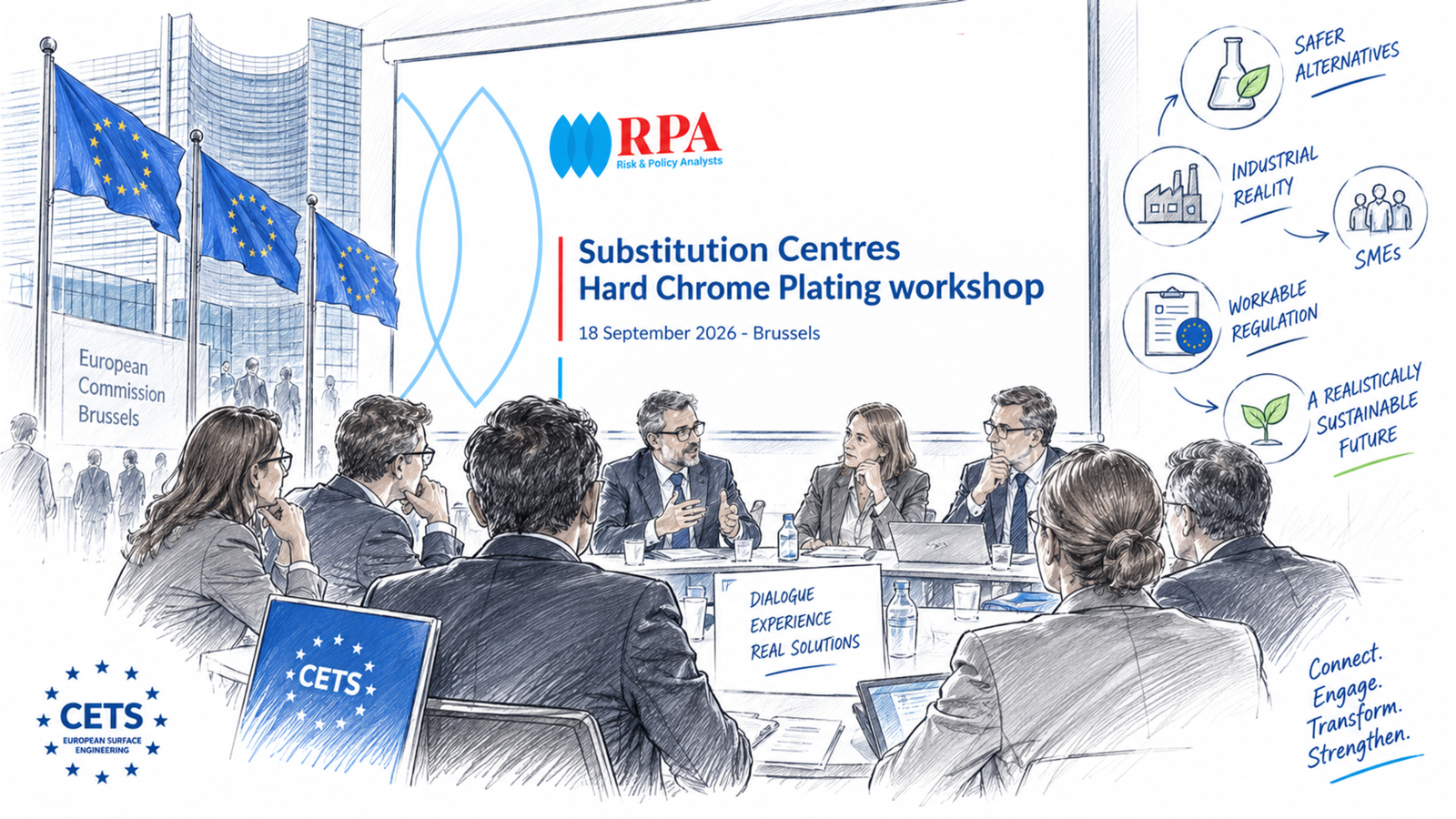
Two intensive days of discussion in Brussels provided an important opportunity to reinforce one of CETS’ key priorities: ensuring that the experience of the European surface treatment industry is directly represented in the regulatory debate.
The workshop took place within the framework of the PPCG project, led by RPA and hosted by Bird & Bird. It brought together industry representatives, SMEs, technical experts and other stakeholders to discuss the practical challenges linked to the substitution of chromium(VI) and, more broadly, the conditions required for a realistic and workable regulatory transition.
For CETS, this type of exchange is essential. Regulatory discussions can only lead to effective outcomes if they are informed by verified industrial experience and by a clear understanding of how companies operate in practice.
During the workshop, SME representatives were able to contribute directly to the discussion and explain, in their own words, the challenges they encounter when implementing substitution processes. These exchanges highlighted the distance that can sometimes exist between industrial reality and the way that reality is represented at regulatory level.
Closing this gap is not only a technical issue. It is also a question of trust.
If future transition pathways are to work in practice, they must be based on an open and credible dialogue between institutions, experts and the companies that are ultimately required to implement regulatory change.
CETS was represented by its President, Malte Zimmer, who contributed the perspective of the European surface treatment sector and helped ensure that the practical realities of the industry remained connected to the regulatory agenda.
Industrial experience was further strengthened by the participation of Stefano Benoni of Benoni srl in Brussels, while Moreno Ghiaroni and Elena Ternelli of Galvanica Nobili contributed remotely, helping to ground the discussion in the everyday operational reality of SMEs.
For CETS, the objective is clear: to maintain a strong and coordinated European industry voice in the regulatory discussion.
The surface treatment sector is highly specialised and serves a wide range of strategic European industries. Any regulatory transition therefore needs to combine ambition with technical feasibility, economic viability and a realistic understanding of industrial processes, customer requirements and the actual availability of alternatives.CETS will continue to bring together national associations, companies and technical experts in order to support a common European position based on practical experience and technical evidence.
The aim is not to resist change, but to contribute to regulatory outcomes that can be implemented effectively and that support both environmental objectives and European industrial resilience.
The work therefore continues towards a future that is ambitious, technically achievable, economically viable and realistically sustainable.
A common voice for a realistic, evidence-based and sustainable transition
Connect. Engage. Transform. Strengthen.