A decisive moment for the future regulatory framework of surface treatment in Europe
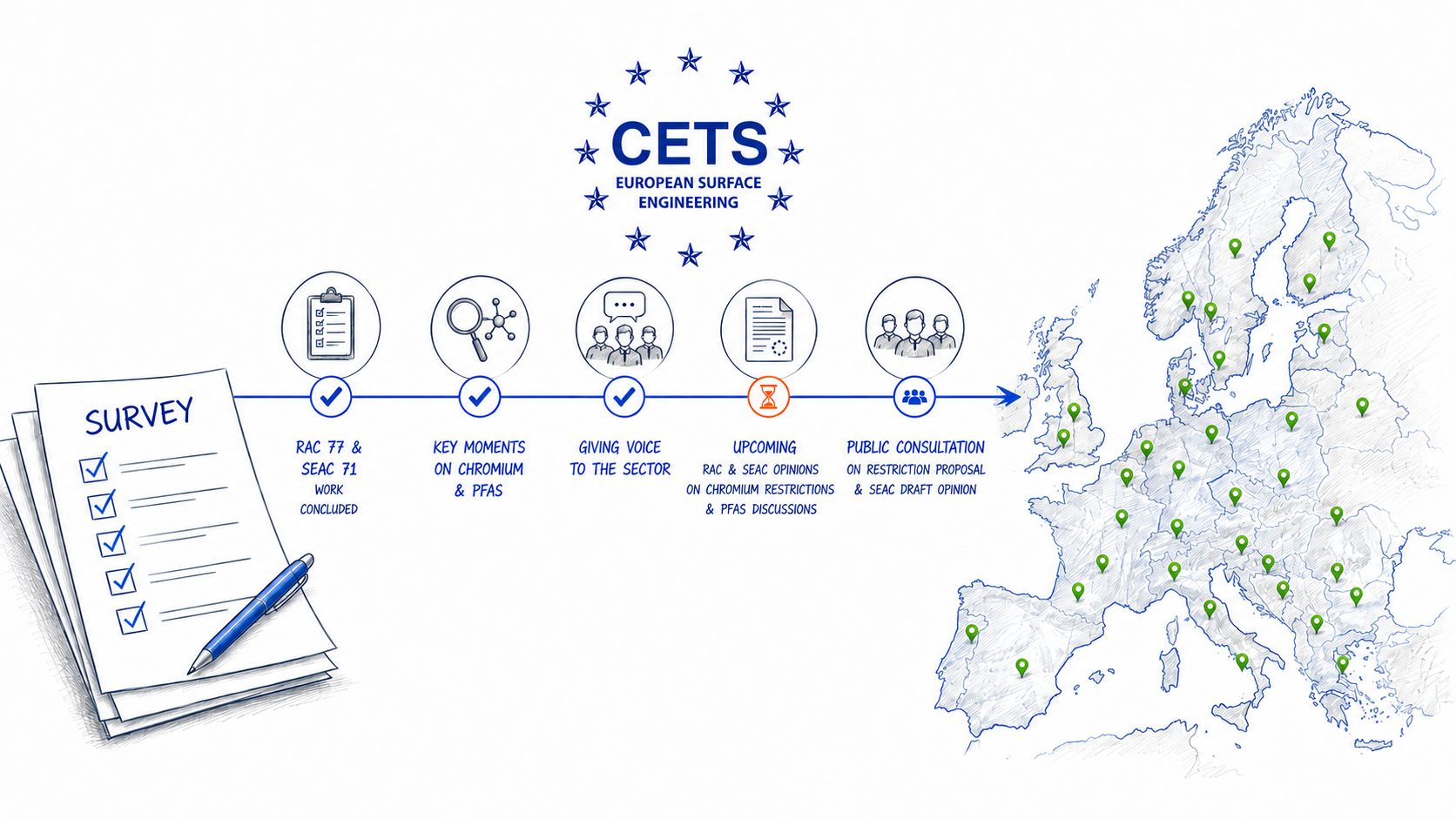
The European regulatory process regarding the restriction of certain substances containing chromium(VI) has entered a crucial phase. The consultation on the SEAC draft opinion will open tomorrow, June 17, 2026, and will remain open for 60 days, until August 17, 2026. This phase represents an important opportunity for stakeholders to provide additional evidence, technical input, and socio-economic information.
For the European surface treatment sector, this consultation is not only a procedural step. It is a decisive opportunity to contribute to the definition of the future regulatory framework that will shape the conditions under which chromium(VI) uses may continue, be substituted, or be progressively transformed in the coming years.
CETS recognises the importance of protecting workers, human health and the environment. At the same time, any regulatory transition must be based on robust evidence, technical feasibility, proportionality and a realistic understanding of industrial processes, customer requirements, certification constraints and the availability of performance-equivalent alternatives.
The surface treatment industry is highly diverse. It includes large industrial groups, specialised SMEs, subcontractors and national supply chains serving strategic European sectors such as automotive, aerospace and defence, energy, mechanical engineering, sanitary sector, medical technologies and advanced manufacturing. For this reason, a one-size-fits-all approach risks overlooking the operational complexity of the sector and the essential role of surface treatment in European industrial resilience.
CETS therefore invites its members, national associations and companies to actively engage in this consultation phase.
The objective is clear: to provide high-quality, evidence-based input that can support a balanced and workable regulatory outcome.
CETS believes that the future framework should not be built only on theoretical assumptions, but on the real conditions under which companies operate and improve. The sector has already invested significantly in risk management, exposure reduction, environmental performance and substitution research. These efforts must be recognised and integrated into the regulatory assessment.
A successful transition cannot be imposed through unrealistic deadlines or technically unachievable requirements. It must be designed through a coherent strategy that combines protection, innovation, proportionality and industrial feasibility.
CETS does not oppose substitution where alternatives are technically suitable, economically viable and accepted by downstream users. On the contrary, substitution is already part of the long-term evolution of the sector. However, alternatives must be assessed against the performance requirements of real applications, including durability, corrosion resistance, adhesion, wear resistance, safety, certification and customer acceptance.
For this reason, CETS will work to coordinate a common European response, bringing together national associations, companies and technical experts. The aim is to avoid fragmented positions and ensure that the voice of the surface treatment sector is heard clearly, constructively and credibly.
This consultation is therefore an opportunity to move from individual concerns to a shared industrial position.
CETS encourages all stakeholders to participate actively, provide data where possible, and contribute to a common strategy for the future of surface treatment in Europe.
Here you have the link for the updated ECHA webpage regarding the restriction proposal
Here you have the link for the direct access to the survey
We will keep you posted about the ongoing discussion about the topic
Connect. Engage. Transform. Strengthen.
A common voice for a realistic, evidence-based and sustainable transition.